Friday, May 30, 2008

Earlier this week I came across a story in the news that gave me pause. The story is below.

Pilots Run Out of Fuel, Pray, Land Safely Near Jesus Sign
WELLINGTON, New Zealand — It seemed like an almost literal answer to their prayers. When two New Zealand pilots ran out of fuel in a microlight airplane they offered prayers and were able to make an emergency landing in a field — coming to rest right next to a sign reading, "Jesus is Lord."

Grant Stubbs and Owen Wilson, both from the town of Blenheim on the
country's South Island, were flying up the sloping valley of Pelorus Sound
when the engine spluttered, coughed and died."My friend and I are both Christians so our immediate reaction in a life-threatening situation was to ask for God's help," Stubbs told The Associated Press on Wednesday.

He said he prayed during the ill-fated flight Sunday that the tiny craft would
get over the top of a ridge and that they would find a landing site that was not
too steep — or in the nearby sea.Wilson said that the pair would have been in deep trouble if the fuel had run out five minutes earlier.

"If it had to run out, that was the place to be," he said. "There was an
instantaneous answer to prayer as we crossed the ridge and there was an airfield — I didn't know it existed till then."After Wilson glided the powerless craft to a
landing on the grassy strip, the pair noticed they were beside a 20-foot-tall
sign that read, "Jesus is Lord — The Bible."

"When we saw that, we started laughing," Stubbs said.Nearby residents provided
them with gas to fly the home-built plane back to base.


One of this things that struck me about this story was the discussion it stirred up on several news blogs. Several people were indignant that this was considered news. To many people this smacked of religious propganda. Several other people defended the newsworthiness of the
above story, but agreed that religious topics were only to be considered news and not
propoganda as long as the story was reported by an "objective" source. Then there was the occasional post by someone quoting scripture (the favorite text quoted was Matt 7:7). The people who thought the entire story was religious propganda were quick to attack anyone who used scripture or said they thought this story was a "miracle."

One of the most common thoughts on the discussion boards went along these lines, "God must have something special for those two since God saved them, but let countless other thousands die that same day." Most expressed that sentiment sarcastically, though there was the very occasional person who thought that literally. In a world filled with drought, earthquakes, cyclones, disease, and many other natural disasters, how do we view the claim by two pilots that God instantaneously answered their prayer for a safe landing? In my opinion, we take it at face value.

As people of faith, it should not seem strange to us that prayers are answered. As people of Christians, we expect God to answer our prayer and so we are actively look for their answer. The same is true with the two pilots in New Zealand, if they had not been actively looking for a place to land, they would have crashed. So it is when we pray for God to be in the midst of the suffereing of this world. Are we actively working towards helping those suffering from natural disasters or other aflictions? If we are, we are able to find God in the midst of the suffering with us. As the Gospel of Matthew says, "‘Ask, and it will be given to you; search, and you will find; knock, and the door will be opened for you."

-David Rose

Thursday, May 29, 2008

Mass Appeal

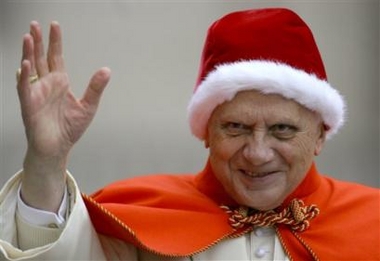
This morning I had a lovely visit with Larry Conrad as we walked through church and he explained the customary liturgical practices as St Timothy's. Some that have great theological reasoning and some that have been done for so long - no one really remembers why! This is, of course, the same in every church. Every worshipping community has their own preference in doing things and even though in the Episcopal Church our worship is universal in terms of the Prayer Book, some churches are high and some are low and some are in between (by high I mean very liturgical, formal, etc. and low being the opposite). This morning's meeting with Larry reminded me of a recent article I read about the changes Pope Benedict XVI has made since his election to the pontificate. No one scrutinizes liturgical changes the way people analyze the pope. Here are some of the differences that might when you points at a trivia contest (from Zenit.org):

"1. The camauro appeared before Christmas, although this Pope does not seem to use the broad Roman hat which matches his red cloak. This made a splash in the news."


2. The Pope seems to use the state stole more than his predecessor."


3. At the meeting with the diplomats for the New Year the Pope used the velvet-and-fur mozzetta (I think this was for winter and seems to have disappeared since Paul VI)."


4. Prelates of honor seem to be resuming the mantelletum and all sorts of clergy are using the biretta, rather openly at papal functions. During the last pontificate these were invisible, although I understand permitted. I do not know what to make of all of this. Is a signal being sent? Is there a move to what my mother called "a touch of class"? Indeed, what are the usual rules for customary "choir dress" for diocesan clergy?”


There are several questions involved. But first a distinction must be made between liturgical vesture and the non-liturgical vesture that popes traditionally wear and those that form part of papal protocol due to his role as a head of state.


Among traditional papal garments are the camauro (a red, fur-lined cap), the broad red-and- gold trimmed hat, and the several formal stoles and mozzettas used when receiving civil dignitaries.


Their use often depends on papal taste. For example, Pope Blessed John XXIII revived the use of the camauro which his predecessors had largely abandoned. Pope John Paul II rarely used the more formal vestures, and since he was Pontiff for so long perhaps many came to believe that they had somehow been abolished.


This was not the case, however, and Pope Benedict XVI has simply opted to use some of the more formal attire that remains part of papal protocol. Thus he has used both the broad-brimmed hat and the camauro on some occasions. Apart from his personal taste, it must also be remembered that the Holy Father began his ministry when he had already turned 78 and probably needs more protection from heat and cold than the athletic John Paul II did when called to be Peter’s Successor at age 58.


Keeping warm was also a motivation for John XXIII’s use of the camauro. He was also elected as an elderly man.


The increase in some aspects of solemnity in papal liturgies is perhaps even more noteworthy. The Holy Father and his personally appointed master of liturgical celebrations have clearly opted to restore some elements that had fallen into disuse, in order to give more splendor to the rites. This can be seen in the style of albs, surplices and vestments used in the celebrations. In some cases this means using older vestments from the pontifical sacristy such as the magnificent golden miter used in the elevation of new cardinals. This miter, emblazoned with the figure of Our Lady of Guadalupe, had been a gift from Mexican Catholics to Blessed Pope Pius IX.


The violet cope used for this year’s Palm Sunday procession was a new and faithful replica of one that had belonged to the renaissance Medici Pope Leo X. The custom has also been revived of having two cardinal deacons, in miter and dalmatic, accompany the Pope in these processions to hold the cope.


The practice of placing the crucifix at the center of the altar in front of the celebrant is certainly a personal initiative of Benedict XVI.He had already made this suggestion as Cardinal Joseph Ratzinger in his book “The Spirit of the Liturgy.” For him this practice is a means of creating a “liturgical east” that helps the celebrant to concentrate on the essential meaning of the sacrifice of the Mass even when celebrating facing the people.


Finally, the vesture of cardinals, bishops, canons and other honorary prelates is still determined by the norms emanated by Paul VI in the 1969 instruction of the Secretariat of State “Ut Sive Sollicite,” substantially repeated in the Ceremonial of Bishops, Nos. 1199-1210.

Wednesday, May 28, 2008

Lord Hear Our Prayer

I remember the Canon to the Ordinary from the Diocese of Georgia saying that when his family would take long road trips, they would recite the Prayers of the People from the Prayer Book. This not only engaged a family in prayer but it also gave a family something to do while they traveled! What a wonderful idea. If you travel this summer, grab a Prayer Book with you. If you don't have one, call me at the church office and I'll make sure you get one. Until then, here's a sampling from the Prayers of the People:

Let us pray for the Church and for the world.
Grant, Almighty God, that all who confess your Name may be united in your truth, live together in your love, and reveal your glory in the world.
Lord, in your mercy
Hear our prayer.

Guide the people of this land, and of all the nations, in the ways of justice and peace; that we may honor one another and serve the common good.
Lord, in your mercy
Hear our prayer.

Give us all a reverence for the earth as your own creation, that we may use its resources rightly in the service of others and to your honor and glory.
Lord, in your mercy
Hear our prayer.

Bless all whose lives are closely linked with ours, and grant that we may serve Christ in them, and love one another as he loves us.
Lord, in your mercy
Hear our prayer.

Comfort and heal all those who suffer in body, mind, or spirit; give them courage and hope in their troubles, and bring them the joy of your salvation.
Lord, in your mercy
Hear our prayer.

We commend to your mercy all who have died, that your will for them may be fulfilled; and we pray that we may share with all your saints in your eternal kingdom.
Lord, in your mercy
Hear our prayer.

Monday, May 26, 2008

Defend them Day by Day

Almighty God, we commend to your gracious care and keeping all the men and women of our armed forces at home and abroad. Defend them day by day with your heavenly grace; strengthen them in their trials and temptations; give them courage to face the perils which beset them; and grant them a sense of your abiding presence wherever they may be; through Jesus Christ our Lord. Amen. (Book of Common Prayer, 823)


Pictures from the 10:30 service of our veterans.


photo by Tony Hamby

Friday, May 23, 2008

Daddy Day

It’s funny how things work out. Yesterday, Fr. Steve asked if I would be willing to write the blog post for today. A thousand different ideas and topics to post have paraded through my mind since. Finally, this morning when the boys woke up, I knew exactly what I wanted to post.

As several of you know, on Friday I stay home with my boys and we have a “Daddy day.” Jonathan, Micah, Elijah and I are able to spend the day together doing all manner of things – playing outside, going to parks, arts and crafts, watching movies, reading books, “cooking” our meals, and building new tracks for their trains. Of course I spend time with Amy and the boys throughout the week, but spending Friday with my sons is something I look forward to, and I like to think that they look forward to it as well. Friday is a time that has been set apart specifically for me to spend time with the boys. On days like today, by spending time with Jonathan, Micah, and Elijah, I am able to observe them as they grow into their different personalities.

It struck me recently that God desires to spend a “Daddy day” with us. Spending a day in retreat with God, doing things that energize your spirit, spending time cultivating your creativity and other spiritual gifts, and allowing space for discovering new insights into all the many ways that you are made in God’s image is something that each of us should plan to do every so often. When was the last time, if ever, you spent a day like that? I am under no illusion that everyone can simply go on retreat whenever they feel they need to. However, setting aside a specific time to be alone with God is something that is not only biblical, but a common practice throughout all of church history.

I am curious to hear what your ideal spiritual retreat would be. How would you spend the day with your “Daddy?”
~ David Rose

Thursday, May 22, 2008

Please pass the Advil

Yesterday morning I did something that I thought would be just a grand idea. Accepting a most generous invitation from a person whose name I shall not disclose to protect the guilty, I set the alarm early to join him in a most pleasant exercise experience. At first I thought 5:45am was not unreasonable. I could go and exercise and still have the rest of the morning to do all the things I needed to do. After all, is there a better to start the day than by embracing the morning sun? Well...I will not continue to embarrass myself with the sad details. Just let me say that at one point I was stretched out on a bleacher desperately trying not to be sick as concerned people walked by asking "Are you okay?" All kidding aside (even though every one of the above statements is accurate), the 5:45am program is a ministry of Calvary Baptist Church here in Winston. They call it Boot Camp. I didn't know if I was in the Army, but I knew I was no longer in Kansas, Toto. It is a wonderful idea that for me address not only a need to lose weight and stay in shape - but it speaks to the heart (or fat) of stewardship.

For far too long we have looked at the word "stewardship" as meaning 'paying our dues' or 'giving our pledge.' Church giving has been viewed almost as a membership fee or alumni dues. And to be fair, many times churches and clergy have framed stewardship in that way. But stewardship is not fundraising. It is not the fee we must pay to call ourselves Episcopalians. Stewardship is taking care of what God has given us. We are blessed with financial resources, yes, even though gas will soon be over $4 a gallon, we are still the richest, most prosperous place on the planet. How do we take care of our financial resources? How do they glorify God?

Our planet is, as Eucharistic Prayer C says, our 'island home.' How are we taking care of the planet God has given us? How is our stewardship? And the same is true with our bodies. Taking care (and I'm speaking to myself) of our bodies is a part of our universal approach to stewardship. Not wasting, investing, giving back - glorifying God.

I remember reading a book on Eastern Orthodox theology in which author stated that the first priest in the Bible was Adam. God gave Adam and Eve the whole world (at least the Garden of Eden) and his task was to "till it and keep it." He was to take what was given and offer it back to God. That is what priests do. In the Episcopal Church, the priest takes the offerings from the people, specifically the bread and wine, and offers a sacrifice of praise and thanksgiving back to God. In the Old Testament, the priests offered the burnt sacrifices back to God. In the fact that we are all a priesthood of believers, our daily task is to take what God has given us (and God has given us everything) and offer it back to him.

That's stewardship.

Tuesday, May 20, 2008

The Vatican and Little Green Men

I'm reminded of a line from Contact, a movie based on Carl Sagan's book of the same name, when a character was asked if they believed if extraterrestrial life - "If there's not - seems like an awful waste of space." I'd love to know your thoughts.

VATICAN CITY (AP) — Believing that the universe may contain alien life does not contradict a faith in God, the Vatican's chief astronomer said in an interview published Tuesday.

The Rev. Jose Gabriel Funes, the Jesuit director of the Vatican Observatory, was quoted as saying the vastness of the universe means it is possible there could be other forms of life outside Earth, even intelligent ones.

"How can we rule out that life may have developed elsewhere?" Funes said. "Just as we consider earthly creatures as 'a brother,' and 'sister,' why should we not talk about an 'extraterrestrial brother'? It would still be part of creation."

In the interview by the Vatican newspaper L'Osservatore Romano, Funes said that such a notion "doesn't contradict our faith" because aliens would still be God's creatures. Ruling out the existence of aliens would be like "putting limits" on God's creative freedom, he said.

Read the whole article.